Up to fifteen percent of children in elementary schools need glasses, according to NBC News. Though kids often aren’t thrilled about the prospect of getting spectacles, parents suffer from their own uncertainties when it comes to navigating this unique form of care and giving young ones an expensive responsibility.
Kids as young as six months can receive prescriptions for glasses, which comes with very different concerns compared with a child who’s six years old. This helpful guide breaks down your child’s needs by age, so you can be better informed about his or her care.
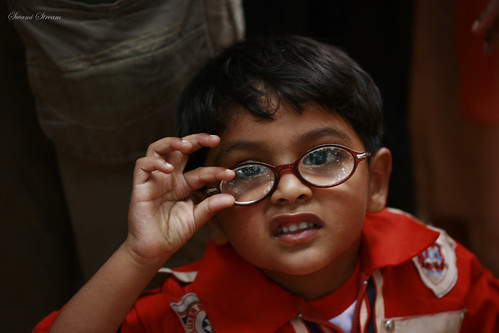
Photo by Flickr user Swami Stream
Six-month-olds to two-year-olds
A child’s eyes are still developing in the first six months of life. The American Optometric Association (AOA) recommends having your child’s first eye examination by the age of six months to make sure her sight meets the standard for children in her age group. Wearing glasses at a young age can help children strengthen weak eyes and equalize a vision imbalance. Children in this age group may not be able to effectively communicate their vision problems, so be sure to look out for signs like the following:
- Your baby’s eyes don’t move in unison
- Lights, mobiles, and toys don’t capture your baby’s attention
- Your baby has a white spot in his eyes in pictures, rather than “red-eye”
- Your baby’s eyes are frequently bulging
- White, light gray, or yellow material build on your baby’s pupils
- Your baby squints frequently
Five- to seven-year-olds
According to optometrists Dr. Hinrichsen and Dr. Richards, the most common form of nearsightedness does not manifest itself until between the ages of five and seven. If left untreated, the condition grows progressively worse every year. The AOA recommends taking your child to the eye doctor right before starting school, and every two to three years after if no vision problems arise. Since five- to seven-year-olds aren’t known for being the most graceful bunch, here are some especially durable features to look for in your little one’s glasses:
- Spring hinges – Connects the temple to the frame and offers outward flexing without damage.
- Plastic lenses – Plastic is not only cheaper, but more durable and lightweight as well.
- A proper fit – Be meticulous about the fit of your child’s glasses. An improper fit can cause them to slide down the nose and, requiring kids to look over the top of the lenses.
- Scratch-resistant coating – The lens manufacturer can usually add this protective element for maximum durability.
Eight- to 12-year-olds
Deciding when the right time is for your child to get contacts is a personal choice that varies on a number of factors. However, a the Contact Lenses in Pediatrics study found that children as young as eight were able to insert, remove, and care for contact lenses with no added risk of lens-related eye complications. Eighty-three percent of the children between eight and twelve said the lenses were easy to care for, while 92 percent decided to continue wearing the lenses after the study. Look for these features in your child’s lenses:
- Breathability – Air Optix brand contact lenses allow five times more oxygen to flow to your eyes compared with regular soft lenses.
- Moisture – Lenses with built-in moisture agents keep contacts comfortable and eyes healthier throughout wear.
- Short life span – Ideally, one-a-day lenses would be a great choice for kids, but these can get expensive. Choose 1-2 week disposable contact lenses for maximum cleanliness and efficiency.
This is a guest post by Marge Wilson. Marge is a widowed mother of two teenage boys who writers about parenting and living as a single mom.